Taxonomy: Nature’s Organization System
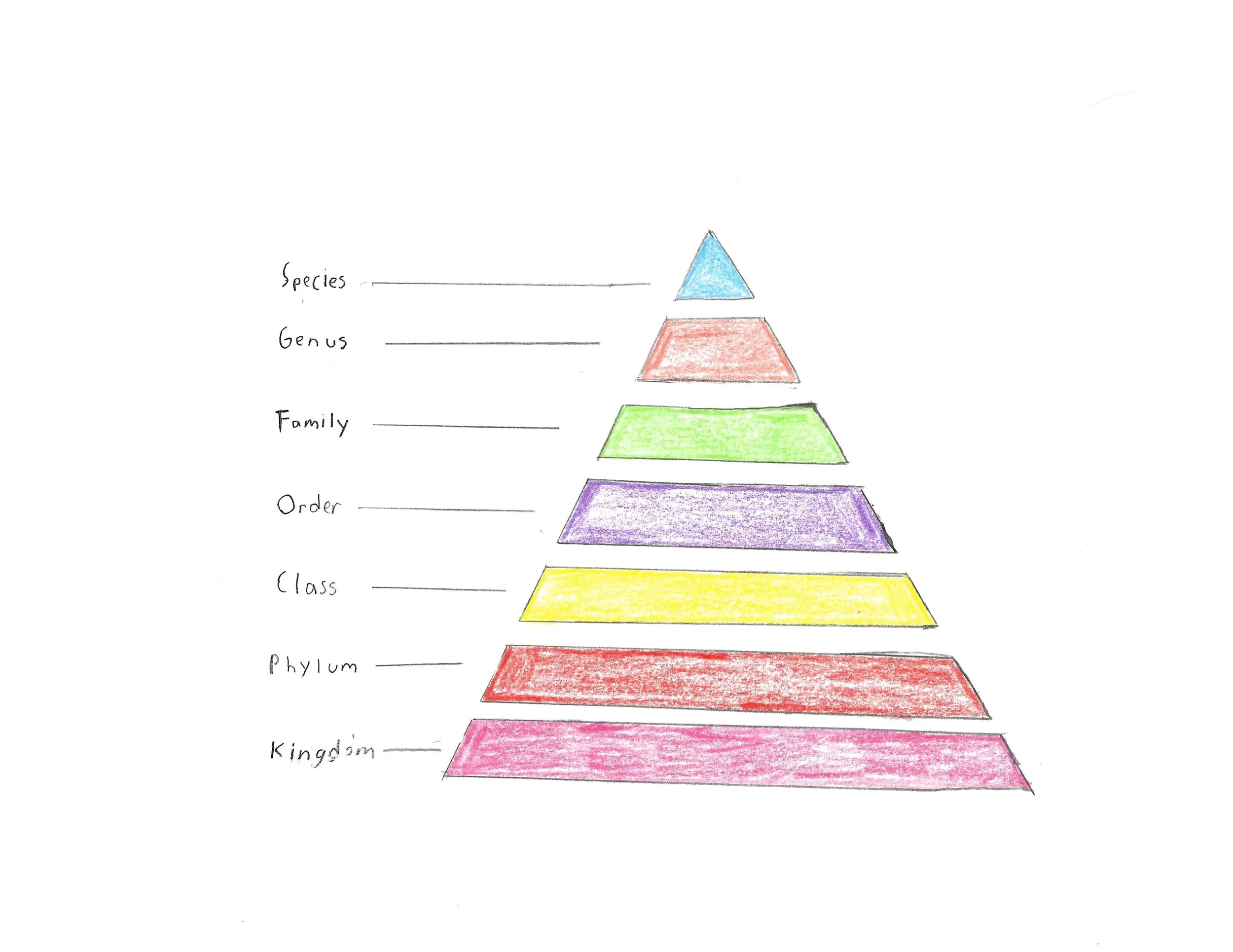
Every living organism on the planet that we know of is put into a system or pyramid. This science is called Taxonomy (Tax-on-o-my). Every animal, plant,or fungus is split into first a Kingdom, then Phylum, Class, Order, Family, Genus, and lastly a Species. This process starts from least specific to most specific. Once a species is finally determined it is given a two word name normally in latin or greek starting with its Genus then species. The process of naming organisms is called binomial nomenclature (by-noh-mee-uhl, noh-muhn-cla-klay-chur) , a system started by Carl Linnaeus (the father of taxonomy) in the 1750s. For example humans' binomial nomenclature or scientific name is Homo sapiens, Homo being the genus and sapiens being the species. There are two levels more broad than the kingdom being the domain and life in general are two of their own classifications.
Enough rambling about the background lets break down each level. Buckle up cause we have some hard science to get into.
Domain
There are three domains of life Eukarya (you-karr-ee-uh) which includes us, Bacteria, and Archaea. The easiest one to explain is Eukarya whose defining characteristic is that their cell or cells have a nucleus (central control center housing things like DNA or Chromosomes). Bacteria and Archaea are very similar, both being single celled organisms. These differences come from their cell wall composition. Bacteria cell walls contain peptidoglycan (pep-tuh-doh-gligh-kan) which is a rigid structure on their cell walls. Archaea on the other hand do not have this and use proteins instead. Another characteristic is their environment. Archaea live are found in extreme environments (high, heat, salt or acid) whereas bacteria can survive almost anywhere including inside of you. Did you know there are 1014 amount of bacteria in your body (that's 1,000,000,000,000,000 that much 1 quadrillion). Don't worry, most of them help you when you eat to digest your food.
Kingdom
The kingdom is the second most broad category. From here on out I am going to focus on Eukaryotes as everything we can see without a microscope is in this domain. You might have heard someone refer to humans as being part of the animal kingdom. That’s true! It is where that saying comes from. In the Eukarya domain there are four major kingdoms: Plante (plants), Animalia (animals), Fungi (mushrooms, mold), and Protista (which is anything that is a Eukaryote but doesn't fit in the other groups). From here on out we will follow a single species, let's take the Siberian Tiger. The Siberian Tiger fits into the kingdom Animalia. This is because to be an animal an organism must be multicellular (multiple cells), no cell walls, the ability to move at some point in its life, heterotrophic (cannot make its own food), and specialized tissue. Now every level we go to more specific all of the requirements from the more broad level apply.
Phylum
A phylum is the next most specific category. There are 39 phyla within the animal kingdom. Our Siberian Tiger and all mammals or fish split off from things like spiders, or all bugs for that matter, jellyfish, crabs, lobsters, octopus, seastars and many many more. Our Tiger belongs to the phyla Chordate (kor-dayt). Well what makes something a Chordate? The first is a hollow dorsal nerve cord which is a hollow nerve cord on the back or top depending on if the animal walks on two legs (bipedal) or four legs (quadrupedal). The second defining trait of a Chordate is a notochord, which is a flexible rod that runs along the body and provides support. In many animals (including humans and tigers), this notochord is only present during early development and later becomes part of the spinal column. Chordates also have pharyngeal slits at some point in their life cycle (which in fish become gills, and in mammals are seen only during early development) and a tail. Because tigers have a backbone and spinal cord, they clearly fit into the phylum Chordata.
Class
Next up is Class, which narrows things down even more. The Siberian tiger belongs to the class Mammalia. Mammals are defined by a few key traits: they have hair or fur, are warm-blooded (endothermic), have three middle ear bones, and females produce milk from mammary glands to feed their young. Tigers check every single box here—fur, live birth, milk for cubs, and internal temperature regulation.
Order
Within Mammalia, the tiger falls into the order Carnivora. Animals in this order are primarily meat-eaters and share specialized teeth called carnassials, which are perfect for slicing meat. This group includes animals like dogs, cats, bears, seals, and raccoons. Even though not all carnivores eat only meat (looking at you), their teeth and skull structure give them away.
Family
Now we’re getting very specific. The Siberian tiger belongs to the family Felidae, also known as the cat family. Members of Felidae are built for hunting: sharp retractable claws, powerful jaws, excellent night vision, and highly flexible bodies. This family includes house cats, lions, leopards, jaguars, and cheetahs. If it looks like a cat and hunts like a cat, chances are it’s a feline.
Genus
The genus of the Siberian tiger is Panthera. This genus includes the “big cats” that can roar, thanks to a specially adapted larynx. Lions, leopards, jaguars, and tigers all belong to Panthera. Cheetahs and cougars, despite being large, do not—and that’s why they can’t roar.
Species
Finally, we arrive at Species, the most specific level of classification. The tiger’s species is Panthera tigris. A species is defined as a group of organisms that can interbreed and produce offspring. Siberian tigers are actually a subspecies, called Panthera tigris altaica, but all tigers—whether Bengal, Siberian, or Sumatran—belong to the same species.
